
Italian regulations are clear when it comes to guaranteeing safety in the workplace: anyone working at height must take specific and mandatory training for working at heights. Whether you are an employee or a worker, knowing where to find the right working at height course and what the mandatory refresher courses are is essential.
The regulations: training course for working at height and fall protection PPE
Italian Legislative Decree No. 81/2008 defines work at height as work that exposes a worker to a fall of more than two metres above a stable surface. Employers must provide training and practical instruction appropriate to the work and equipment used.
The work at height training course is not a simple bureaucratic procedure, it is an essential process that covers:
- Risk assessment: identification of the specific hazards associated with height
- Safety procedures: operating techniques for performance of the work
- Correct use of PPE: training on the harness, ropes, connectors and on fall prevention Personal Protective Equipment (PPE) in general
- Planning rescue: the protocols to be following in the event of an accident
This has a dual purpose: preventing the fall and, if it occurs, limiting the damage it causes. A working at heights certificate is issued on completing the course, certifying eligibility of the worker.
Where to find the working at height course and mandatory refresher courses
The training must be provided by accredited and qualified agencies. Generally speaking, you can find the working at height course at:
- Accredited training agencies (such as Aifos, Confartigianato, etc.)
- Equal partnership organisations (formed by employers’ associations and trade unions)
- Companies specialised in occupational safety who satisfy the criteria established by the regulations
It is important to choose courses that offer both a theoretical part and practical training in the field, as this latter part is what effectively prepares the worker for the actual operating conditions.
How long does the working at height course last and what does it involve
Generally speaking, the length of the working at height course varies between 4 and 8 hours, depending on the complexity and the practical part planned.
The most widely used format comprises:
- a theory module (regulations, risks, PPE)
- a practical module (training with harnesses, lifelines, fall prevention systems)
At the end of the course, a working at heights certificate is issued, which is essential for being considered as “eligible” to work at heights.
Mandatory refresher training: how often is it necessary?
Refresher requirements depend on the type of training, the worker’s duties and the equipment used. Under Italy’s State–Regions Agreement of 17 April 2025, general worker safety training is refreshed at least every five years. Check the requirements for the particular task and qualification. Refresher training reinforces safe procedures and helps workers stay up to date on changes to equipment and risks.
Many companies prefer to provide more frequent refresher courses, particularly if the equipment changes or specific risks increase.
Evolution of protection: going beyond the traditional fall prevention PPE
Until very recently, attention was focused on the fall prevention system (harness, lifeline, etc.). Nowadays, the technology offers state-of-the-art solutions for protection: WorkAir.
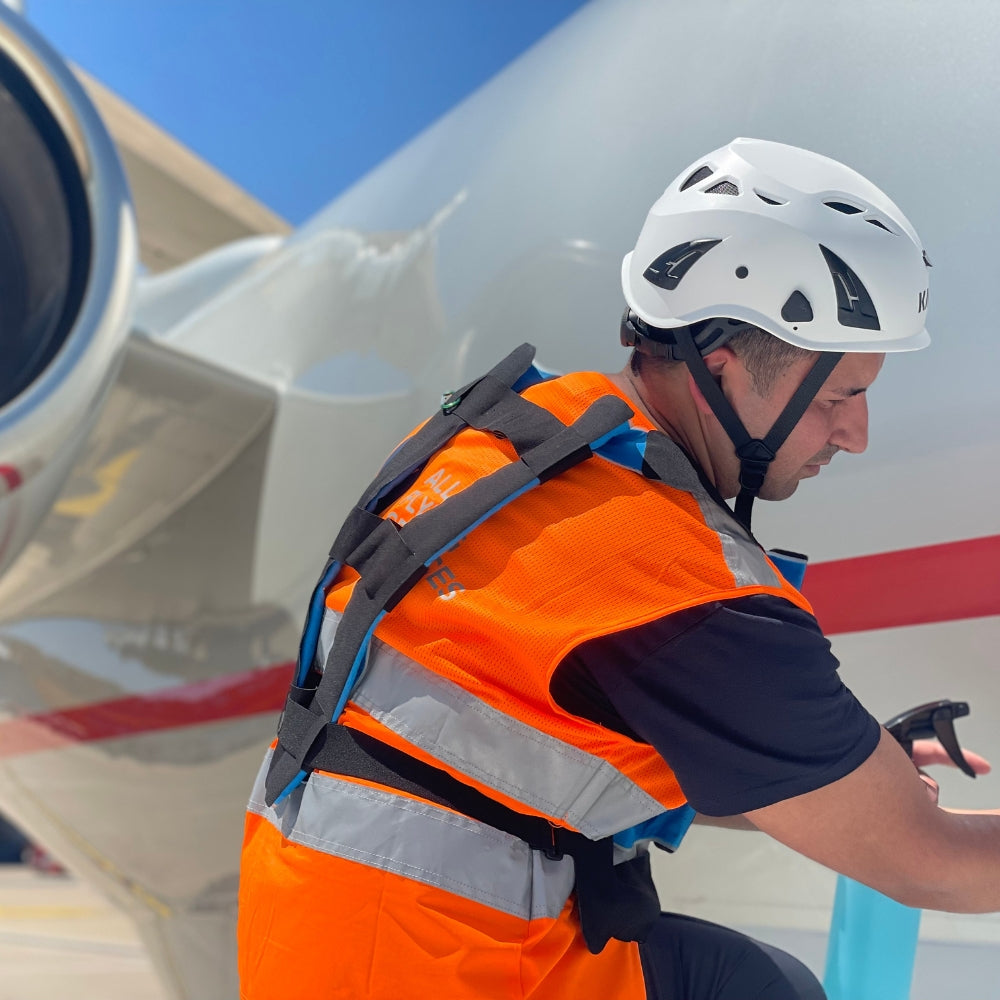
While the primary objective of the working at heights course is preventing the accident, the new frontier is to minimise the consequences when the fall is unavoidable. The range of WorkAir airbag vests is an innovation in Category II PPE, offering prompt protection.
The WorkAir vest is designed to detect when the fall starts and inflate in just a few milliseconds. This creates a protective “pillow” around the worker’s torso, reducing the impact and preventing serious trauma to the vital organs – often the most critical injuries caused by falling from a height.
Combining WorkAir with correct use of traditional fall prevention PPE means providing the worker with a dual level of safety: prevention (with the harness) and additional protection against the impact (with the airbag).
Contact us to learn more about WorkAir.