
When discussing operations performed at a certain height from the ground, the terms “working at heights” and “working off the ground” are often used interchangeably. However, in terms of work safety and particularly the required Personal Protective Equipment (PPE) and the applicable regulations, there are substantial differences that it is essential to understand. This difference is not just a question of semantics, but a crucial discriminating factor in guaranteeing the utmost safety and full compliance with current laws.
What does working at heights mean? The key definition
Under Article 107 of Italian Legislative Decree No. 81/2008, work at height is work that exposes a worker to the risk of falling from more than two metres above a stable surface. This can apply to work on roofs, scaffolding, ladders and elevated work platforms.
The implications of this definition are immediate:
- Assessment of risks: a specific fall risk assessment is mandatory.
- Specific PPE: use of fall protection PPE (ropes, energy absorbers) and anchors is required.
- Specific training: workers must receive specific training on the risks and on use of PPE for working at heights.
Working off the ground: a broader or specific concept
The term working off the ground is often used in a more generic context to indicate any type of work that is not performed at ground level. It could also include activities that do not fall strictly within the definition of working at heights according to Legislative Decree no. 81/08 (for example, working at a height under 2 metres from the ground, but with the risk of falling onto dangerous obstacles). However, in practice and in Italian legislation, when reference is made to working off the ground, safety and specific PPE to prevent serious falls, this almost always refers to working at heights and to the 2-metre threshold.
Different PPE required: the key to safety
The distinction is crucial because it means the different PPE is required. For working at heights, a complete fall protection system is essential, comprising three basic elements:
- The harness: a full-body harness (UNI EN 361) that wraps around the worker’s body, distributing the forces in the event of a fall.
- The connection system:ropes, energy absorbers (UNI EN 355), connectors (UNI EN 362) that connect the harness to the anchor. The energy absorber is vital in reducing the impact on the body in the event of a fall.
- The anchoring point:a fixed and sturdy point (UNI EN 795) to which the fall connection system is connected, capable of supporting the forces produced by a fall.
In addition to these components, other PPE may also be required, such as protective helmets (UNI EN 397), gloves and safety shoes, depending on the specific context of working at heights.
Applicable regulations: Legislative Decree no. 81/08
In Italy, the main legislation governing safety when working at heights is Legislative Decree no. 81/08, also known as the Occupational Health and Safety Laws Consolidation Act. This decree establishes the obligations for employers, workers and professional advisors insofar as concerns safety. In particular, for working at heights, the preventive and protective measures to be adopted are detailed, together with the training need, the choice and use of PPE and the importance of planning for emergencies.
WorkAir: innovative PPE for working at heights
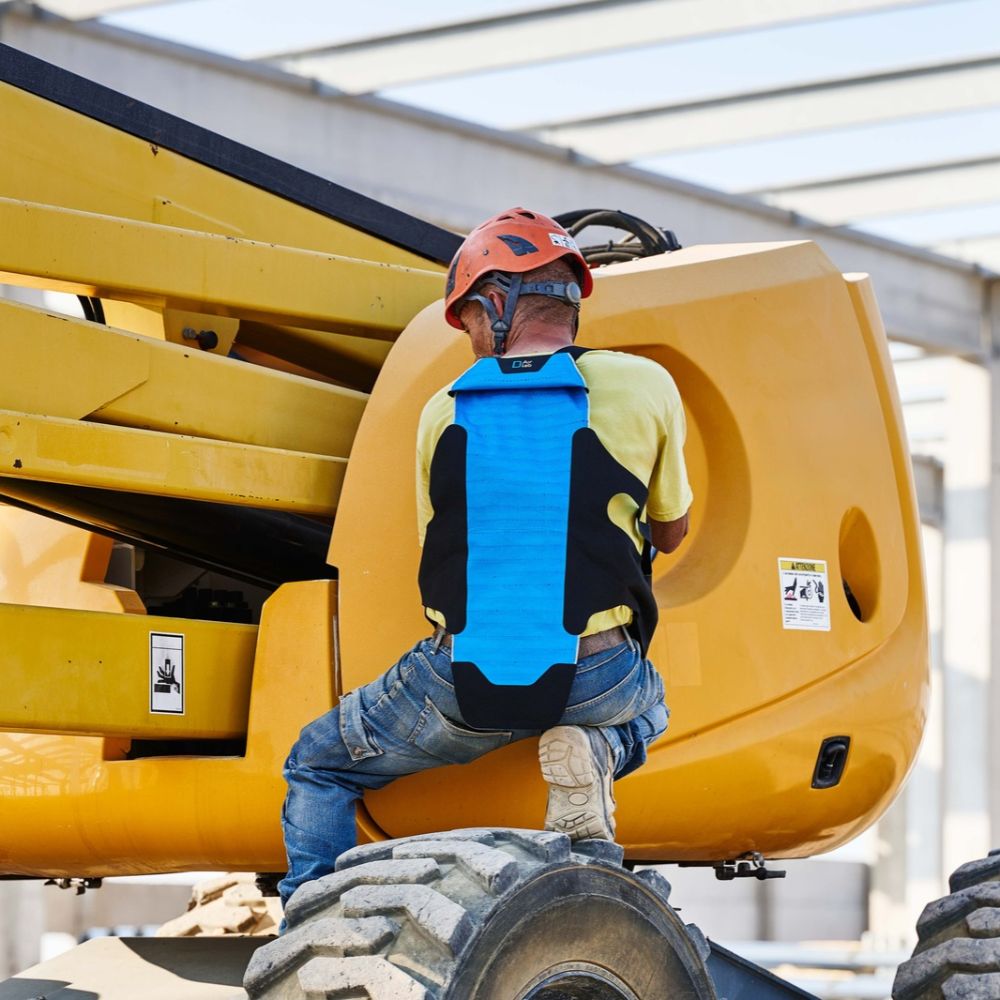
Although adopting traditional and mandatory PPE is fundamental, technological innovation is offering increasingly state-of-the-art solutions for further improving safety. This includes WorkAir, an innovative airbag for working at heights that offers a further layer of protection for workers.
WorkAir is wearable personal protective equipment that uses airbag technology. Use it with a compatible fall protection harness where one is required, following the manufacturer’s instructions. The airbag inflates in 40 milliseconds after a fall is detected. It covers vulnerable areas of the body and absorbs part of the impact energy.
Where a fixed anchorage point is unavailable, the risk assessment must identify suitable fall-prevention or fall-arrest measures. WorkAir can provide additional impact protection against residual risk.
WorkAir is not a fall protection device, but rather a protector in the event of a fall. Addition of a WorkAir does not replace the obligation of using a harness and a fall protection system for working at heights, but adds a proactive level of protection, further improving safety in working off the ground and at heights. It is a tangible example of how technology can contribute to ensuring that working at heights is increasingly safer.
Contact us to learn more about WorkAir!